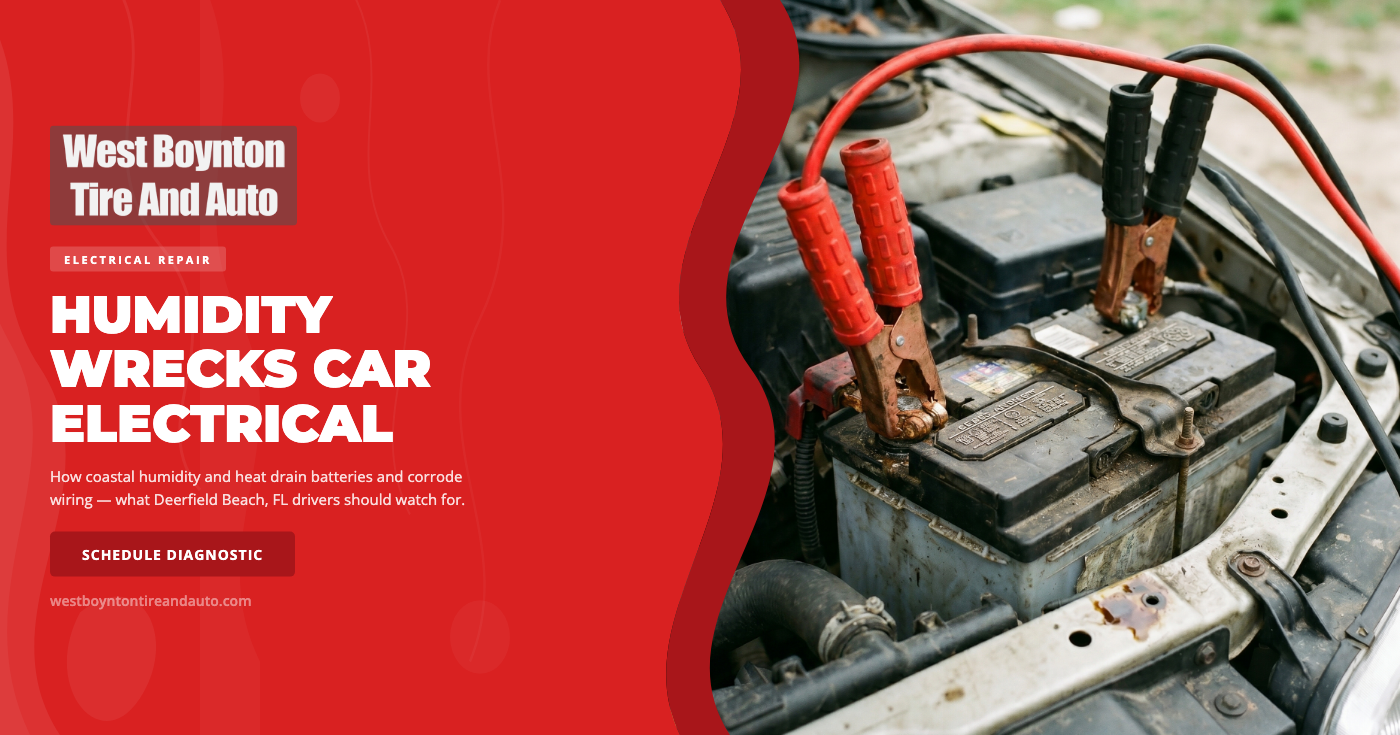
If you drive in Deerfield Beach, FL, your car's electrical system is under more stress right now than at any other time of year. July humidity, sustained heat, sun loading, and coastal salt air combine into the toughest environment your vehicle's wiring, battery, and alternator will face all summer. Systems that ran fine in April can start acting strangely in July — flickering dash lights, slower cranking in the morning, an intermittent no-start after a long parking-lot soak.
At West Boynton Tire and Auto, we diagnose and repair car electrical problems for drivers throughout Deerfield Beach, Delray Beach, and the surrounding South Palm Beach County area. Here's what Florida's summer conditions do to your car's electrical system, how to recognize the warning signs, and what a professional electrical diagnostic actually involves.
Why Florida Humidity Is Tough on Your Car's Electrical System
Deerfield Beach summers routinely push relative humidity above 80% for weeks at a time, with overnight lows that rarely drop enough to let moisture dry out from under the hood. Every metal contact in your car's electrical system — battery terminals, ground straps, sensor connectors, fuse box lugs — sits in an environment that promotes corrosion around the clock. Corrosion is not a cosmetic problem: it introduces electrical resistance exactly where the system needs clean, low-resistance connections.
When a connector corrodes, the voltage that arrives at the sensor, module, or accessory on the other end drops. Modern vehicles are extraordinarily sensitive to this. A body control module expecting 12.4 volts may see 11.8 volts across a corroded ground, and it responds by throwing intermittent fault codes, dropping accessory functions, or in some cases refusing to allow the engine to start. Add sustained under-hood temperatures above 200°F when the vehicle is running, and the thermal cycling between hot operation and humid cool-down accelerates the corrosion process every single day.
The result is the pattern Deerfield Beach drivers know well: electrical gremlins that come and go, symptoms that show up one morning and disappear the next, warning lights that flash briefly and then reset. These are almost never random — they are almost always Florida humidity slowly working on a specific connection somewhere in the system.
Common Electrical Problems for Deerfield Beach Drivers
Corroded battery terminals — The most common electrical complaint we see in Deerfield Beach vehicles. White, blue, or green crystalline buildup on the battery posts adds resistance to every electrical circuit in the car. Early symptoms include slow cranking, dim headlights at idle, and radio presets that reset after the car has been sitting overnight. If left untreated, terminal corrosion eventually causes a complete no-start.
Failing alternators from sustained load — Your alternator runs continuously in Florida summer. Between the A/C compressor, cooling fans, and full accessory load, the electrical demand is at its yearly peak. An alternator with worn brushes or a marginal diode pack may keep up in mild weather and fail to keep up in July. The battery starts each morning with a partial charge, drops lower over the day, and eventually can't start the car.
Weak or dead batteries — Florida heat is harder on batteries than cold weather. Extreme heat accelerates the internal chemical breakdown that ends every lead-acid battery's life. Most car batteries in Deerfield Beach last only two to three years, compared to four or five years in cooler climates. If your battery is more than two years old and starting to crank slowly, it is telling you something.
Ground strap failures — The braided copper straps that connect the engine, chassis, and body ground points are frequent corrosion victims. A single degraded ground can produce a wildly confusing set of symptoms — flickering interior lights when you use the turn signal, tachometer dropouts, A/C blower speed changes when you brake. These are ground problems, not accessory problems.
Water intrusion in modules — Deerfield Beach's summer rain events can push moisture past worn door seals, cabin filter housings, and under-hood grommets. Once water reaches a control module — body control, transmission control, or the fuse box itself — the resulting corrosion inside sealed connectors is expensive to repair and impossible to diagnose without proper electrical testing.
Alternator vs. Battery: How to Tell What's Failing
When your car won't start reliably, the question we hear most often is: is it the battery or the alternator? The symptoms overlap, but the diagnostic pattern is different, and the fix is completely different.
Signs it's the battery: Slow cranking that gets worse over several days. A single rapid clicking sound when you turn the key. Interior lights that dim significantly when you try to crank. A car that starts fine after a jump but eventually dies again after sitting overnight. Corrosion around the terminals or a swollen case. If your battery is older than two years in Deerfield Beach's climate, its condition should already be under regular monitoring — see our car battery service page for testing and replacement information.
Signs it's the alternator: Headlights that dim at idle and brighten when you rev the engine. Dashboard warning lights labeled BATT, ALT, or a battery-shaped icon. A burning rubber or overheated-wire smell from under the hood. Electrical accessories cutting in and out — radio, power windows, HVAC blower — with no obvious pattern. A car that starts, runs for a few minutes, and then dies as the battery loses the last of its stored charge because the alternator has stopped providing new charge.
The quick diagnostic: Jump-start the car. Once it's running, disconnect the jumper cables. If the engine keeps running normally, the battery was the problem — the alternator is holding up the electrical system on its own. If the engine dies within seconds or minutes, the alternator has failed and the battery was simply the last thing keeping the car alive. This test is not a substitute for a full electrical diagnostic, but it tells you which way the fault is pointing.
Warning Signs You Shouldn't Ignore This Summer
The following symptoms deserve a professional electrical diagnostic before they escalate into a stranded-vehicle situation. In Deerfield Beach summer conditions, marginal electrical problems tend to become non-marginal quickly.
Slow cranking that has developed over the past two to three weeks — even if the car still starts every time, the trend is telling you the battery, the alternator's charging output, or a corroded connection somewhere in the starting circuit is degrading. Waiting until the car doesn't start at all costs you a tow.
Any dashboard warning light that references the charging system, battery, or a general electrical fault. These are not decorative — the vehicle's monitoring system has detected a measurable problem and has flagged it.
Electrical accessories that behave inconsistently: power windows that work sometimes and not others, radio presets that reset, HVAC fan speeds that change on their own, dome lights that flicker when you close the door. Individual accessory faults are rare — inconsistent behavior across multiple accessories almost always points to a shared electrical fault: a corroded ground, a marginal battery, or a failing alternator.
Any smell of hot electrical insulation, burning rubber, or acid from under the hood. This is not something to drive on. Pull over, shut the engine down, and have the vehicle inspected before continuing.
How Coastal Salt Air Speeds Up Electrical Corrosion
Deerfield Beach sits directly on the Atlantic coast, and that location means your car's electrical system deals with something inland vehicles do not: airborne salt. Even a few miles from the water, ocean breeze carries microscopic salt particles that settle on every exposed metal surface, including under-hood electrical components. When morning humidity coats those particles in a thin film of moisture, you have an electrolyte — the exact chemistry needed to accelerate corrosion of copper terminals and steel connector housings.
Salt-driven corrosion progresses faster than the humidity-only corrosion inland drivers experience. A battery terminal that would take five years to develop noticeable buildup in Orlando may show visible corrosion in Deerfield Beach within eighteen months. The same is true of ground straps, wiring harness connectors near the fenders, and any wiring routed through the front bumper area behind the grille — every one of these locations is in the direct path of salt-carrying air pushed forward while driving.
Regular inspection is the only reliable defense. Salt-related corrosion is easy to spot early — a light dusting of white or greenish powder on a terminal is the beginning stage — and simple to clean and protect with dielectric grease at that point. Once corrosion has worked its way inside a sealed connector or worked through the crimp of a wire terminal, repair means replacing the component, not cleaning it.
What to Expect During an Electrical Diagnostic
A professional electrical diagnostic is not a quick visual check. When you bring your vehicle to West Boynton Tire and Auto for electrical service, our ASE certified technicians follow a systematic process designed to isolate the actual fault rather than throw parts at the symptoms — see our auto diagnostics service page for a full description of the process.
The diagnostic starts with a full battery load test — not a simple voltage check, but a test that draws real current from the battery to measure how it holds up under load. We measure the alternator's charging voltage at idle and at higher engine speeds, verify the charging system is producing the correct current output, and check for excessive AC voltage ripple that indicates failing diodes inside the alternator.
From there, we move to the scan tool. Modern vehicles record a substantial amount of electrical data — historical fault codes, module communication logs, voltage snapshots during specific events. Reading this data often reveals the pattern behind an intermittent fault that never appears in the shop.
If the fault points to a specific circuit — a slow parasitic drain that kills the battery overnight, a corroded ground affecting multiple modules, an intermittent wiring fault — we use a digital multimeter and, if needed, an oscilloscope to trace the circuit and identify the exact failure point. Only then do we recommend a repair. This approach avoids the expensive pattern of replacing parts based on symptoms and hoping one of them fixes the problem.
Trusted Electrical Service for Deerfield Beach Drivers at West Boynton Tire and Auto
If your car's electrical system is showing any of the summer warning signs described above, contact West Boynton Tire and Auto for professional car electrical repair near Deerfield Beach, FL. Our ASE certified technicians provide comprehensive electrical diagnostics, battery testing and replacement, alternator repair, and corrosion remediation for drivers throughout Deerfield Beach, Delray Beach, Boynton Beach, and the surrounding Palm Beach and North Broward County communities. With more than twenty years of experience diagnosing the specific ways Florida's climate affects vehicle electrical systems, we identify the actual cause of your electrical problem before recommending any repair. Schedule your electrical diagnostic today.